Introduction
We are happy to announce the release of Dasharo (coreboot+SeaBIOS) v26.09.00.01 for PC Engines apu2 and its siblings. The full changelog is available in the Dasharo documentation.
Although the apu2 platform has been on the market for over a decade, it is still widely used in networking appliances, routers and firewalls. This release keeps the firmware up to date with upstream coreboot, adds security features like measured boot and SBOM, and fixes several long-standing issues related to IOMMU and memory configuration. Let’s walk through what’s new.
Added
Rebased on coreboot 26.09
The firmware has been rebased onto the official coreboot repository commit
8b0e34f, tagged as 26.09. This brings all the upstream improvements and
fixes that landed since the previous release. See the coreboot 26.09 release
notes for
details.
Measured Boot
Measured boot is now enabled. Firmware components are measured into the TPM
PCRs and recorded in the TPM event log, provided a TPM module is attached to
the board. This lets the operating system or a remote verifier check what
firmware actually executed on the platform. Both SHA-1 and SHA-256 PCR banks
are extended. Below is an abbreviated TPM event log from an apu4 with an
Infineon SLB9665 TPM 2.0 module, as reported by cbmem -L. coreboot measures
its stages and blobs into PCR 2 and ACPI tables into PCR 1. Then SeaBIOS
continues the chain with its configuration files and the boot process:
|
|
The same log is exposed to the operating system and can be parsed with
tpm2-tools:
|
|
SBOM Generation for All Firmware Components
A Software Bill of Materials (SBOM) is now generated for all firmware components: coreboot, SeaBIOS, sortbootorder, iPXE and others. It makes it easier to track what exactly is inside the firmware image and verify the provenance of each component.
We are also making progress with the SBOM and provenance of the firmware components, as measured and reported in the TPM event log. A new report that validates the origin, reproducibility and hashes of the firmware components is now part of the release artifacts. You can find these reports on the release page.
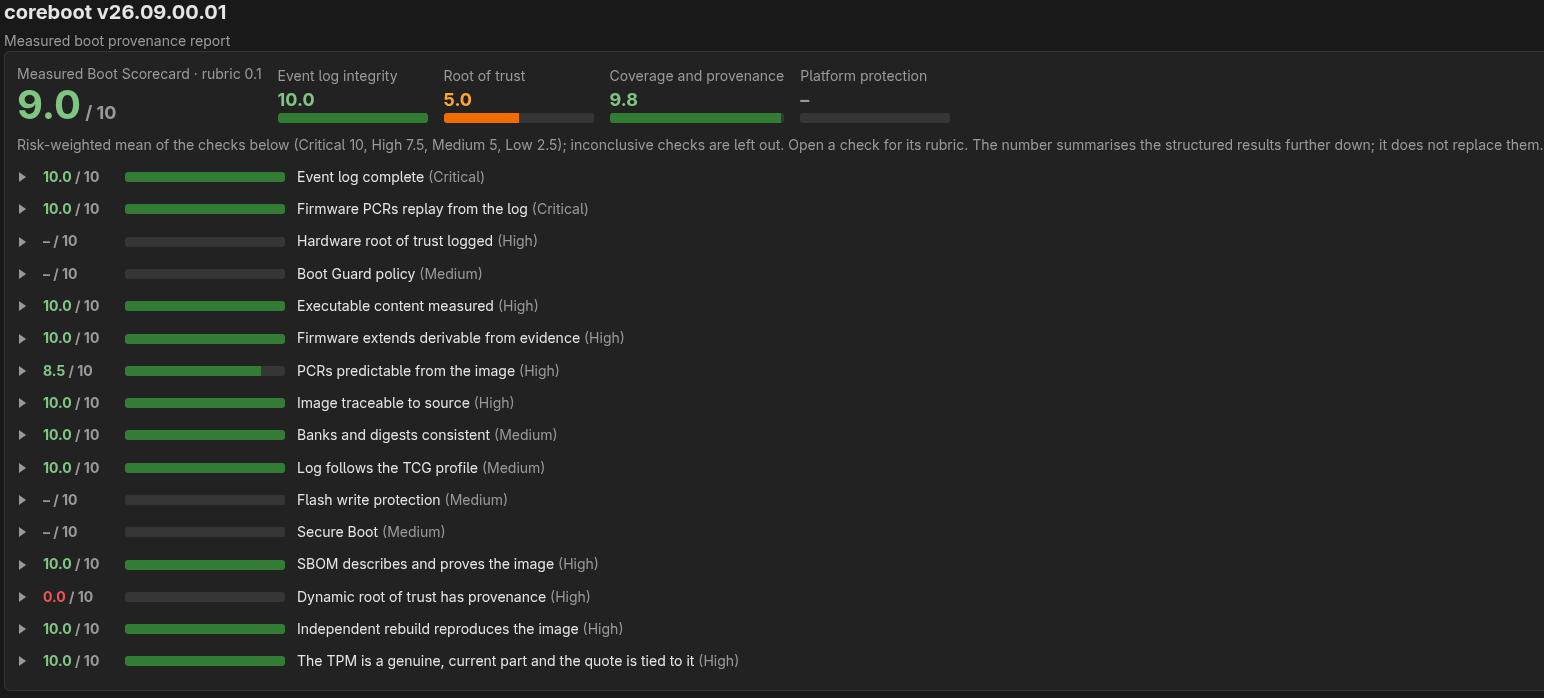
The report above was generated for v26.09.00.01 on an apu4. The event log is complete, the firmware PCRs replay correctly from the log, all executable content is measured, the image is traceable to source and an independent rebuild reproduces it bit for bit.
The lower root of trust score is expected - apu2 has no hardware root of trust like Intel Boot Guard, so the measurements start from the coreboot bootblock itself, which is a software root of trust.
IOMMU Device in ACPI with Interrupt Routing Information
The IOMMU device was missing in ACPI, along with its interrupt routing information. It is now properly described, so the operating system can correctly route the IOMMU interrupts.
Unique SMBIOS System UUID
The SMBIOS System UUID is now generated from the NIC MAC address, making it unique for each board and stable across reboots and firmware updates. This is useful for provisioning and management tools that identify machines by their UUID. SeaBIOS prints it on boot:
|
|
and it is also visible in the SMBIOS tables:
|
|
The last 6 bytes of the UUID (000db955c641) are the MAC address of the first
NIC, which makes the UUID unique for each board.
Changed
sortbootorder and SeaBIOS Updates
- sortbootorder has been updated to v26.09.00.01.
- SeaBIOS has been updated to rel-1.16.3.2.
Builds Are No Longer TIMELESS
Previously, the firmware was built with the TIMELESS option to keep the
builds reproducible, at the cost of not having meaningful build timestamps in
the image. The builds no longer use TIMELESS, while reproducibility is
preserved thanks to the updated code preparation and git patch application
process. See the dasharo-pq
documentation for
details.
Reworked IOMMU IVRS Table Generation
The IOMMU I/O Virtualization Reporting Structure (IVRS) ACPI table generation has been reworked to cover the whole PCI root bridge. Combined with the IOMMU fixes described below, this should improve the experience with PCI passthrough and virtualization on apu2.
Larger cbmem Console
The cbmem console size has been increased to 1MB, so that it can fit the debug
logs from SeaBIOS as well. This makes debugging boot issues easier, as the
whole log can be retrieved with the cbmem utility from the operating
system. The new
console size is visible in the CBMEM table of contents:
|
|
Fixed
Linux Freezes Caused by IOMMU Guest APIC
The IOMMU guest virtual APIC feature was enabled, even though the hardware does not support guest AVIC. This caused Linux to freeze. The feature is now no longer enabled on the apu2.
Switching to IOAPIC Mode Moved to ACPI _PIC Method
Switching the GNB (Graphics North Bridge) IOAPIC to IOAPIC mode has been moved
to the ACPI _PIC method. This way, the interrupt mode is switched only when
the operating system declares it uses the APIC interrupt model, instead of
being forced by the firmware.
CC6 Save State Area Not Reserved
The memory used by the CPU to save the core state when entering the CC6 (core C6) power state was not reserved in the memory map. The operating system could use that memory, which could lead to memory corruption when the cores entered the deep sleep state. The region is now properly reserved.
Incorrect Reserved Bits Cleared in the ECC Register
The firmware cleared incorrect reserved bits when configuring the ECC register. This has been fixed, so the ECC configuration no longer touches bits it should not.
Summary
This release keeps the PC Engines apu2 firmware current with upstream coreboot and brings it closer to the security standards of the other Dasharo platforms, with measured boot, SBOM and provenance reports. The IOMMU rework and fixes should make the platform more stable for virtualization use cases.
We encourage everyone to update, test, and share your experiences through GitHub issues.
Unlock the full potential of your hardware and secure your firmware with the
experts at 3mdeb! If you’re looking to boost your product’s performance and
protect it from potential security threats, our team is here to help.
Schedule a call with
us
or drop us an email at contact<at>3mdeb<dot>com to start unlocking the
hidden benefits of your hardware. And if you want to stay up-to-date on all
things firmware security and optimization, be sure to sign up for our
newsletter: