.png)

Introduction
Dasharo v0.9.0 for the Gigabyte MZ33-AR1 server board was released on May 14, 2026. This marks the culmination of many months of porting work that started with the very first coreboot bring-up in Part 1 and progressed through hardware topology discovery, I/O bus configuration, ACPI porting, upstream contributions, and extensive testing. If you have not been following the series, all previous posts are tagged mz33-ar1.
The build is based on coreboot 25.12 (revision b7796125), EDK II
edk2-stable202502 (revision eedcdea6), iPXE 2026.02 (revision ad8cbcee),
and AMD openSIL (revision df18968a of the turin_poc branch released on
11th April 2025).
Features in v0.9.0
The release delivers initial Dasharo firmware support for the Gigabyte MZ33-AR1 based on AMD Turin. The feature set is rich and includes:
- Rebased coreboot repository to 25.12 upstream tag
- UEFI compatible boot interface with standard boot order and boot options configurability
- UEFI Secure Boot support
- Tested Ubuntu 25.10 and Windows 11
- TPM support with TPM Measured Boot
- SMM BIOS write protection with AMD ROM Armor
- Setup menu password configuration to protect unauthorized access to firmware setup
- USB stack and network disable options in setup menu
- TPM PPI support with UEFI variable backend, for platforms that do not retain RAM contents after reset
- Integrated SBOM in the binary with extended SBOM information for AMD PSP blobs
- AMD SME and AMD SEV-SNP support
- UEFI Capsule Updarte v1 support with Capsule on Disk
(Note that this version of UEFI Capsule Update does not enforce signature verification. See DSB 002 for more details.) - Rebased iPXE on last commit of February 2026
- Customizable the SMBIOS Serial Number and UUID
- Support for firmware flashing via BMC with RBU files
- TCG OPAL and SATA disk password support
- Boot manager menu disable option
- Early graphical sign of life
- Quiet boot/Fast boot options
- AMD memory context save/restore support to speed up subsequent boots
- SMBIOS 3.8.0 specification support
- AMD PSP HSTI reporting to reach fwupd HSI2 level and fulfill HSI4 requirements
- AMD CPU temperature reporting via ACPI Thermal Zone
And more…
Known issues in v0.9.0
The v0.9.0 release documents four known limitations:
-
UEFI Capsules do not survive resets. Only immediate Capsule on Disk (CoD) updates are supported; a warm reset during a staged capsule update will not complete the update. This is a limitation of the modern AMD platforms where staged capsule are lost in RAM after reset, likely due to memory encryption or PSP memory initialization.
-
Previous power state restoration does not work for the powered-off state. The ATX power state restore (S5 -> power-on when AC is restored) is not functional. Systems that require keeping previous state after a power outage cannot rely on this feature in v0.9.0. Only the “always on” or “always off” options work reliably.
-
I3C controller initialization fails in Linux. The AMD Turin SoC includes an I3C (Improved Inter-Integrated Circuit) bus controller, which Linux attempts to initialize during boot. The controller initialization currently produces errors in the kernel log. Administrators using I3C-attached devices (such as certain BMC sensors) should be aware of the limitation.
-
Fast Boot does not reduce boot time. The Dasharo setup menu option to enable Fast Boot has no measurable effect on total firmware boot time in this release. The feature flag is present in the menu but the underlying optimization path does not improve the boot time in a significant way. Still, Dasharo firmware boots much faster than vendor firmware:
- Dasharo: < 15 seconds (without PSP), or < 55 seconds (with PSP)
- vendor BIOS: over 2 minutes (without PSP), or over 3 minutes (with PSP)
None of these issues affect core functionality such as OS booting, PCIe device enumeration, SATA storage, USB peripherals, network access, or secure boot.
Testing environment improvements for AMD platforms
Alongside the firmware release, the open-source-firmware-validation framework has received a set of improvements targeting AMD-based platforms, tracked in OSFV repository on the Dasharo validation repository.
Temperature monitoring
The sensor library was extended with support for reading CPU temperatures on AMD systems. Previously, the automated test suite could not collect thermal data on AMD platforms - a gap that made it harder to verify thermal limits and detect anomalous temperature behavior during long-running stability tests.
BIOS menu navigation
Several improvements were made to how the test framework interacts with the firmware setup menu:
- Removed delays when pressing Enter - particularly important for iPXE menus, where tight timeouts could cause the test framework to miss the entry window
- Added delays between menu re-entries - prevents EDK2 from unexpectedly traversing back two form levels when a menu is entered twice in rapid succession, an issue that caused intermittent test failures on Gigabyte MZ33-AR1
Firmware flashing guards
Flash-related tests now include AMD-specific guards:
- The framework will not attempt to flash an FD image directly on AMD CPU platforms, where the flash chip layout and write protection rules differ from Intel platforms
- Region-based flashing operations no longer pass region arguments on AMD processors, avoiding failures caused by unsupported flash region configurations
Platform configuration for MZ33-AR1
The gigabyte-mz33-ar1.robot platform configuration file was updated with
the settings needed for automated testing:
- Intel ME menu options are conditionally disabled (not present on AMD)
- Option ROMs are enabled to support network boot validation
- Non-standard Ethernet naming conventions are configured
- Capsule-on-Disk firmware update flow is enabled
- F10 is set as the boot menu hotkey, matching the MZ33-AR1 firmware
These additions mean the MZ33-AR1 can now be integrated into the same automated test infrastructure that validates other Dasharo-supported boards, enabling regression testing to run on every firmware build.
fwupd HSI
The fwupd HSI tests show a very high security level (HSI2) with all requirements. for HSI4 met:
|
|
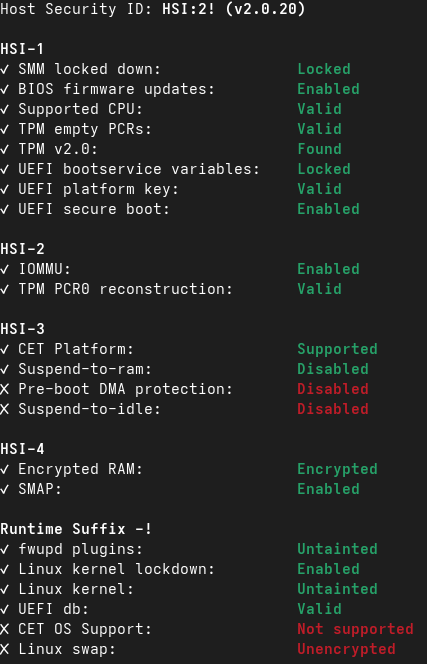
The Encrypted RAM test requires the mem_encrypt=on parameter in the Linux command.
line for the test to PASS.
SPI write protection requires enabling the SMM BIOS write protection in
Dasharo Security
Options.
UEFI secure boot and Linux kernel lockdown may be achieved by enabling
UEFI Secure Boot.
SPI replay protection is unfortunately unsupported by the SPI flash chip
used on the Gigabyte MZ33-AR1 board, so the test will not pass. The test is
only shown if running the tool without sudo.
Suspend-to-idle test to pass requires fixes from this
PR.
There are some tests that can only be passed with superuser privileges, and some will never pass with superuser privileges. For example:
TPM PCR0 Reconstructionmay require sudo, if the user is not in thetssgroupCET OS Supportwill always fail with sudo, due to how the test is designed and how it worksSMM locked downtest will fail without sudo, unable to access required MSRSPI replay protectiondoes not show up on the list when used with sudoSuspend-to-idlefails when run with sudo, with changes from this PR.
If not for the SPI replay protection and Suspend-to-idle test (and the
sudo caveats), the platform could reach HSI4. Pre-boot DMA protection is a
software feature in the firmware that configures the IOMMU during the firmware
POST. It could be implemented in Dasharo in the future.
Openness score
One of the metrics Dasharo tracks for each supported platform is the openness score: the fraction of the firmware image that consists of open-source code vs. closed-source binaries. The Dasharo (coreboot+UEFI) v0.9.0 compatible with Gigabyte MZ33-AR1 v0.9.0, compared to the vendor firmware image, reduces the closed-source footprint by 80%!. See the comparison table.
The analysis of the 32 MiB gigabyte_mz33_ar1_v0.9.0.rom image gives the
following breakdown:
| Category | Size |
|---|---|
| Open-source code | ~1.57 MiB (24.1%) |
| Closed-source code | ~4.95 MiB (75.9%) |
| Data | ~1.98 MiB |
| Empty space | ~23.5 MiB |
The dominant contributor to the closed-source portion is AMD firmware are the PSP (Platform Security Processor) binaries - AMD-specific initialization blobs that ship as pre-compiled binaries. On a server-class platform such as the MZ33-AR1, these blobs are a hard dependency - the processor will not initialize without them, and AMD does not publish their source code.
A score of 23.1% open-source is in line with what is typical for modern x86 server platforms where AMD or Intel proprietary firmware is required for silicon bring-up. The same structural constraint applies to Intel-based servers that depend on FSP (Firmware Support Package) blobs. The coreboot + OpenSIL + EDK II combination used in this release maximizes the amount of open-source code in the host firmware; what remains closed is exclusively the silicon vendor firmware that has no open-source equivalent.
The full per-region breakdown is available in the openness score documentation.
Summary
Dasharo v0.9.0 for the Gigabyte MZ33-AR1 delivers initial open-source firmware for the AMD Turin server platform, built on coreboot 25.12 and AMD openSIL. It brings a comprehensive feature set including UEFI Secure Boot, TPM Measured Boot, AMD SME/SEV-SNP, TCG OPAL disk passwords, full PCIe, SATA, and USB support, and SMBIOS 3.8.0 compliance. The release is accompanied by an extended automated test environment for AMD platforms and an openness score of 23.1%.
Four known issues remain for future iterations: UEFI capsule staging across resets, power state restoration from S5, I3C controller initialization failures in Linux, and the non-functional Fast Boot option.
The firmware is available as part of the Dasharo Pro Package exclusively through the Full Build for Gigabyte MZ33-AR1 bundle in 3mdeb’s shop.
Huge kudos to the NLnet Foundation for sponsoring the project.

Unlock the full potential of your hardware and secure your firmware with the
experts at 3mdeb! If you’re looking to boost your product’s performance and
protect it from potential security threats, our team is here to help. Schedule
a call with
us
or drop us an email at contact<at>3mdeb<dot>com to start unlocking the
hidden benefits of your hardware. And if you want to stay up-to-date on all
things firmware security and optimization, be sure to sign up for our
newsletter:
Be sure to join the Dasharo openSIL integration status meetings, where the Dasharo team will walk through where open-source firmware is with openSIL and FSP integration. Book space in your calendar!
Also do not miss the inaugural Boot Security Mastery Conference (BSMConf) this year. A five-day event combining practical education with industry knowledge exchange around securing the platform boot chain, provisioning roots of trust and platform hardening.