.png)

Introduction
Apple published the most comprehensive platform security documentation in the industry. The Apple Platform Security Guide (December 2024 edition, covering iOS 18.1) is the version we studied for this article. Instead of dismissing it because it’s closed-source, what if we read it as a blueprint?
From my perspective, the Apple Platform Security Guide represents state-of-the-art documentation of platform security. It is really great from the perspective of explaining to the community what the security features are and how those are used. We want to endorse Apple’s approach of providing such documentation, despite the fact that many people in the community will say it’s still closed source, still proprietary, still not transparent and not auditable.
“To make the most of the extensive security features built into our platforms, organizations are encouraged to review their IT and security policies to ensure that they are taking full advantage of the layers of security technology offered by these platforms.” – Apple Platform Security Guide, p. 6
The purpose of the document is mostly for other organizations to maximize leverage of the features provided by Apple. This may be some marketing, but it is very to the point. Other organizations could benefit from using this as a good example and deliver similar documents from their side. We are looking for organizations that are transparent, trustworthy, and auditable, heading in a different direction than Apple. But we recognize the design pattern and recommend the ecosystem follow a similar motivation for explaining their technology.
At 3mdeb, as part of the Dasharo team, we care deeply about pre-OS security. Our Zarhus team focuses more on the OS side, but always with the goal of leveraging Dasharo vertically. So we read this through a firmware engineer’s lens. Many of Apple’s security patterns already exist in the open source firmware ecosystem, or could be leveraged there with synergy between open source firmware, operating systems, and the broader software ecosystem. One thing evident in the Guide is that hardware-based security features cannot be disabled by mistake: secure by design, secure by default, the same mindset present in OpenBSD.
What is Apple T2 and Why Should Firmware Engineers Care?
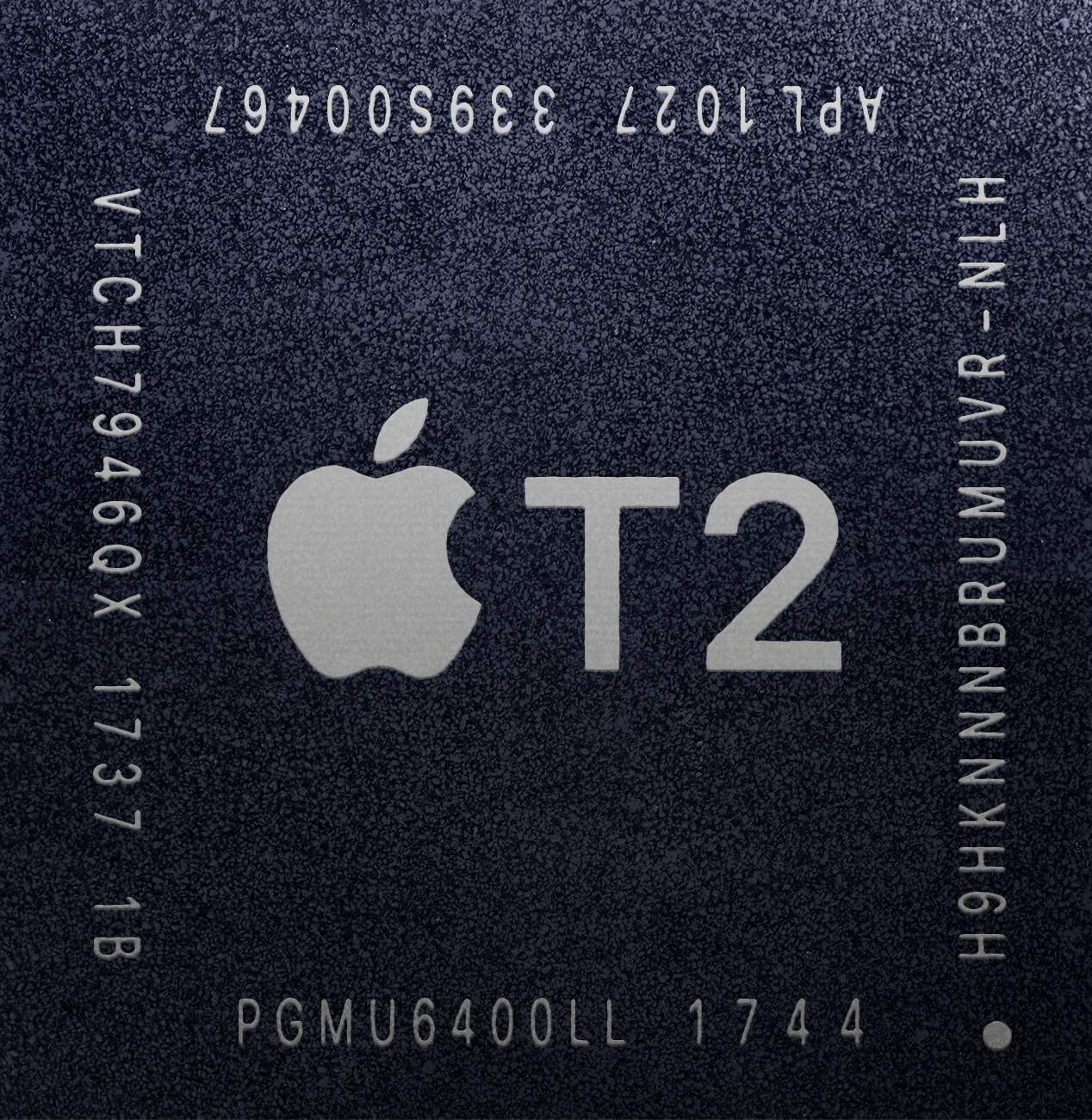

T2 is a custom SoC security chip for Intel-based Mac computers, essentially an A10 (the iPhone/iPad application-processor family) embedded in a Mac. This is important because Apple’s documentation states that T2 boot is analogous to how A-series chips boot securely. Learning about T2 and understanding how T2 works, we can assume that newer processors boot in a similar manner.
Apple has not shipped Intel Macs in new designs since 2022, and on Apple Silicon (M1 and later) the Secure Enclave is integrated directly into the main SoC instead of living on a discrete chip. T2 is therefore the last generation where the security coprocessor is physically separate, which is also why it remains the cleanest reference model for reasoning about equivalent designs on x86. The same boot-chain principles carry forward into M-series; only the packaging changes.
T2 contains two processors: an ARMv8.1-A 64-bit application processor and an ARMv7-A 32-bit Secure Enclave Processor. It has its own AES engine for decrypting the system SSD on the fly. The encryption keys are derived from chip-unique UID/GID fuses inside T2 and never leave the Secure Enclave, so an SSD physically removed from a T2 Mac cannot be decrypted in a PC or in another Mac even though the drive itself is readable.
Secure Enclave Architecture
The Secure Enclave is a dedicated secure subsystem integrated into the Apple system on chip, and the Secure Enclave Processor is the CPU inside of it. That distinction matters: the Secure Enclave is the entire subsystem, the Secure Enclave Processor is just one component.
The components within the Secure Enclave subsystem:
- Random Number Generator creates entropy
- Internal AES engine uses hardware keys derived from the UID (unique per device, fused at manufacturing) and GID (shared per SoC generation)
- Public Key Accelerator (PKA) handles RSA and ECC operations
- Secure Enclave Processor is the dedicated CPU that runs sepOS, an L4-based microkernel
- Memory Protection Engine encrypts all communication between the Secure Enclave and external memory with ephemeral keys generated at each boot
There is also an I2C bus which connects to Secure Nonvolatile Storage. All user data encryption keys are rooted in entropy stored here. This separate chip survives SoC replacement, preserving critical security state even if the main processor is swapped during repair.
In the Apple ecosystem, T2 effectively replaced the role that Intel Management Engine plays on other platforms. This design choice speaks volumes about trust: if Apple, with their deep Intel partnership, chose to build their own security coprocessor rather than rely on ME, the open source community should take note.
A Note on Trusted Execution Technologies
Apple Secure Enclave is treated as a Trusted Execution Environment which is a composite of a dedicated processor. ARM TrustZone is just a CPU mode separation in Normal World and Secure World. And then we can also classify x86 SMM (System Management Mode) as a TEE-like isolated mode. Those are three main technologies which we can classify in a similar way, and understanding one helps reason about the others. For a comprehensive treatment of trusted execution technologies in firmware context, see Jiewen Yao and Vincent Zimmer’s Building Secure Firmware (Apress, 2020).
Notably, Intel Management Engine (ME) and AMD Platform Security Processor (PSP) serve similar roles as isolated coprocessors, but with a crucial difference in trust model. In the Apple ecosystem, T2 replaced Management Engine’s role entirely, handling secure boot, disk encryption, and sensor access. Apple did not trust the existing Intel ME for these functions. If Apple, with their engineering resources and Intel partnership, chose to replace ME rather than rely on it, the open source community should ask the same question. The Dasharo project follows a binary blob policy that minimizes unnecessary blobs and supports disabling Intel ME on every platform where hardware remains stable without it.
How Apple Boots: Two Parallel Chains of Trust
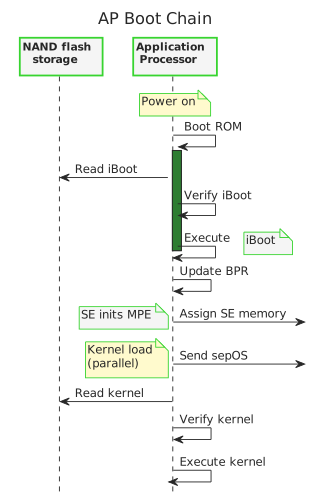
Like Intel Management Engine or AMD PSP, the Apple security coprocessor must boot before the main CPU: on Intel Macs T2 powers on first, verifies its own chain (Boot ROM -> iBoot -> bridgeOS), then reads the UEFI firmware from SPI flash, verifies it, and only then releases the Intel CPU from reset. This ordering is inherent to being the root of trust: whatever verifies the main CPU’s first code must already be running by the time that code is fetched.
Apple’s documentation describes the boot process for iPhone and iPad, and states that T2 follows the same pattern. We take this at face value and describe the shared chain below, calling out Intel Mac differences (like bridgeOS) where they appear.
The Application Processor chain starts with Boot ROM. The Apple Platform Security Guide describes it:
“When an iPad and iPhone device is turned on, its Application Processor immediately executes code from read-only memory referred to as Boot ROM. This immutable code, known as the hardware root of trust, is laid down during chip fabrication and is implicitly trusted.” – Apple Platform Security Guide, p. 36
ROM is burned into silicon during manufacturing. It contains a built-in CA public key for signature verification; if the signature of the loaded firmware is invalid, it enters Device Firmware Update mode. From A10 onward, the extra Low-Level Bootloader stage was eliminated: Boot ROM loads iBoot directly. Fewer stages, smaller attack surface.
iBoot is the first mutable code in the boot chain. It handles hardware initialization (memory controller, display, storage) and updates Boot Progress Registers to signal boot mode to the Secure Enclave. It assigns a memory region for the SE and sends sepOS for verification, then loads and verifies the kernel.
On iOS 14+, Apple modified the C compiler toolchain to build iBoot with improved security:
“Apple modified the C compiler toolchain used to build the iBoot bootloader to improve its security. The modified toolchain implements code designed to prevent memory- and type-safety issues that are typically encountered in C programs.” – Apple Platform Security Guide, p. 36
In practice, that covers buffer overflows, heap exploitation, type confusion, and use-after-free. Boot ROM is not covered because mask ROM cannot be updated, so only the mutable stage is hardened. iBoot was historically targeted by exploits. Unlike Boot ROM vulnerabilities, iBoot issues can be patched via software updates, so they do not persist across releases.
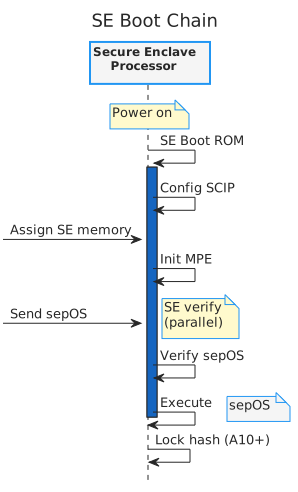
The Secure Enclave chain runs in parallel: SE Boot ROM configures SCIP (System Coprocessor Integrity Protection), initializes the Memory Protection Engine, receives sepOS, verifies it, and executes. SCIP is configured before receiving sepOS, providing coprocessor isolation. When SCIP is configured and the Application Processor has assigned memory, the Memory Protection Engine can be initialized. After iBoot sends sepOS, both chains work simultaneously. Kernel load does not wait for the Secure Enclave. This parallelism is important for boot performance.
Boot Progress Registers and Kernel Integrity Protection
Apple defines data protection classes that determine when encrypted data is accessible. Class A (Complete Protection) discards the key 10 seconds after the device locks, protecting health data and banking apps. Class B (Protected Unless Open) allows in-progress writes to finish, like mail attachments downloading in background. Class C (Protected Until First Authentication) keeps keys available after the first unlock until reboot, covering most app data. A fourth Class D (No Protection) exists on iOS for always-accessible system files and is not used on macOS.
Apple devices have three boot modes: normal boot, recovery mode, and Device Firmware Update (DFU). Boot Progress Registers tell the Secure Enclave which mode we are in, and the Secure Enclave decides which encryption keys to release. In DFU, even Class D is locked, so nothing decrypts. In recovery, Classes A, B, and C are inaccessible while Class D still reads. In normal boot, full access after user authentication.
Physical access during recovery or update is a common attack vector: the attacker forces the device into DFU or recovery and asks the Secure Enclave to release keys under those semantics. BPR are set by immutable Boot ROM (for DFU) or verified iBoot (for recovery), so the SE can tell which mode a given boot actually entered and refuses to release keys for classes that are out of scope. The x86 equivalent is TPM PCR values: boot state determines what secrets are accessible. PCR-based LUKS sealing is the direct analog.
Kernel Integrity Protection (KIP) is another mechanism set up during boot before the OS kernel runs. The memory controller provides a protected physical memory region, and the kernel becomes read-only after boot with no runtime modification. The Application Processor at some point has to load the kernel, and this is done by iBoot. Essentially iBoot configures the region in the memory controller, loads the kernel and kernel extensions (kexts), then locks the region by denying any writes, and transfers control. The kernel cannot modify itself because any attempt to modify kernel code after passing control is denied and causes a fault.
The security properties are:
- No writable kernel mappings, so even the kernel cannot write to its own code
- No executable code outside the protected region, preventing code injection
- Configuration is locked at boot, and the attacker cannot reconfigure that
In x86, memory controller lock is similar to UEFI DXE image protection, as
both are set at the bootloader stage. There is a signal in UEFI
(EndOfDxe and SmmReadyToLock) sent at the end of the configuration
phase (see EDK2 MemoryProtection.c for implementation).
After this, image sections marked as code become read-only. Making
this mandatory, not optional, across all implementations would be a clear
improvement.
What Can Go Wrong: The checkm8 Story
The best example of what can go wrong is checkm8 (CVE-2019-8900), a use-after-free in the DFU USB handler. DFU mode handles USB directly from Boot ROM, without an OS underneath and without ASLR. When a USB transfer was aborted mid-operation, the DFU handler freed the IO buffer but failed to clear the global pointer, a classical C memory safety bug.
By carefully sequencing about 20-30 USB operations, attackers positioned a controlled data structure containing a callback function pointer at the freed buffer’s address. When Boot ROM called through the dangling pointer, it executed attacker-controlled code. Physical USB access was required; no remote exploitation.
Researchers dumped Boot ROM, analyzed Secure Enclave protocols, and earned persistence that survives OS updates. It is unfixable because mask ROM is burned into silicon.
Why does this matter for us? The same class of bugs may exist in UEFI proprietary BIOS recovery paths. The USB stack in EDK2 is a significant attack surface, which is why Dasharo provides the ability to disable USB stack in firmware for security-conscious deployments.
Anti-Rollback: Personalized Signatures vs TPM Sealing
The traditional anti-rollback approach uses a global signature combined with a Secure Version Number (SVN), which only increments. This breaks if an attacker can reset the stored version counter, allowing downgrade to vulnerable firmware. SVN is also present in Intel Authenticated Code Modules (ACMs), making this problem relevant across platforms.
Apple’s solution binds signatures to the device’s ECID (Exclusive Chip ID, a hardware chip identifier burned into silicon). When the device requests a firmware update, it contacts Apple’s signing server, which checks the current security epoch and produces a signature valid only for that specific chip. An older firmware version simply will not receive a valid signature. Since each signature is device-specific, it cannot be transplanted to another device.
In the x86 ecosystem, TPM_Seal with PCR0 firmware policy achieves a similar
goal. The sealed key only becomes available when boot measurements match the
expected configuration. This is not unique to Apple; it is a common attestation
pattern. The difference is that Apple enforces it at the infrastructure level,
while in open source firmware it remains opt-in.
Intel Mac with T2: Where Apple Security Meets x86
On Intel Macs, the T2 chip powers on first, runs Boot ROM, verifies iBoot, then transitions to bridgeOS. BridgeOS reads the UEFI firmware from SPI flash, verifies it, and memory-maps it over eSPI to the Intel CPU. Only then is the Intel CPU released from reset. No Intel Boot Guard is needed because T2 is the entire root of trust.
T2 offers three secure boot policies. Full Security uses ECID-bound signatures. Medium Security uses global Apple signatures. No Security disables verification of the host CPU firmware entirely, enabling custom OS installation. The T2 chip itself always secure-boots; only the Intel side is affected. M1 removed the No Security option. T2 Macs were the last to offer true boot freedom. On non-Apple x86 platforms, the platform owner is the decision maker about what boots. The goal in the open source ecosystem is always full owner control, not control in the hands of the vendor.
Five Opportunities for Open Source Firmware
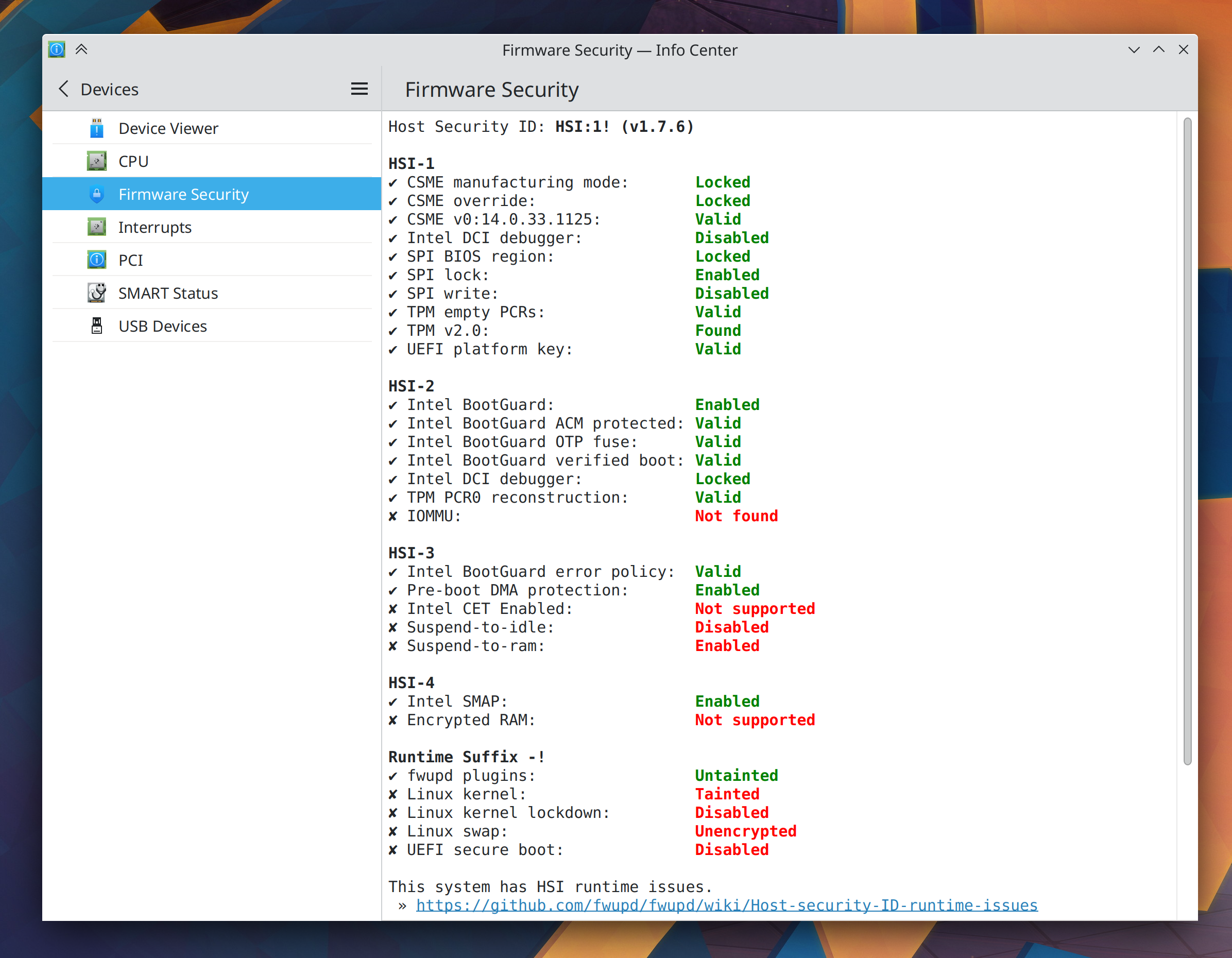
Apple has advantages we don’t have. First of all, they’re doing custom silicon. They have very good vertical integration. They have a closed ecosystem. They have enough margin to hire good engineers, so they can work on all these features. That’s why the open source ecosystem has to do things differently, because we differ in the resources and the ability to create that kind of vertical integration. But we should not give up, and we should not admit that open ecosystem cannot gain the same or similar properties. And in fact, many principles translate to x86 with TPM and probably the upcoming ARM ecosystem. In case of x86, it doesn’t matter if this is Intel or AMD, because similar features are provided. So let’s look at what we can actually do.
Opportunity 1: PCR-Gated Operations
Apple’s BPR gates data access by boot state. Our TPM PCRs can do the same, but we mostly stop at disk encryption. The innovation is using PCR state to gate other operations, especially firmware update and remote attestation. We can imagine that we can create PCR-based gates, which gate firmware-related actions to PCRs.
We can imagine an open source firmware update mode. Currently the flow is that the user enters the setup menu and enters firmware update mode and the update proceeds. This firmware update mode through firmware update tools or maybe even capsule update could warn the user if the PCR values don’t match the expected known-good configuration. Users can still force the update, but they’re informed that the platform may be in an unexpected state. They can be conscious that maybe someone compromised their system.
A BIOS setup screen could show current PCR values, where the user can take a photo of it. Maybe even there could be a QR code for easy opening of the link. Then there is a public API endpoint for remote attestation. Anyone can verify platform state before trusting it. Essentially, they open the link which was created and the result tells them that this set of PCRs is good, is expected for this version of firmware, for example, or this version of firmware with this configuration. Like GrapheneOS Auditor, but for firmware.
An enterprise version of that feature does the same, but for the fleet. We have backend introspection into what’s going on in my fleet of devices, what’s their state. Platforms submit attestation to the server, the server verifies and alerts on anomaly.
Opportunity 2: Forward Sealing for Updates
Forward sealing solves the PCR0-changes-on-update problem. Right now firmware update changes PCR0, and LUKS keys become inaccessible because of the change.
Before the update, compute expected PCR values for the new firmware version and seal keys to both current and future PCR. After update, old seal fails, but new seal works. Then of course, if the system booted and we can confirm that everything is fine, we can remove the old seals. Or we can simply forward-seal to the new value and assume that it will reboot correctly. Or if it will not reboot correctly, we could have some recovery procedures through a PIN or whatever additional policy for unsealing. As always, the most important point is make it great UX and do not destroy the feature because of bad UX.
Opportunity 3: Qubes Boot Modes with Power Transition Hardening
Another use of PCR-gated operations: Qubes boot modes with power transition hardening. We could imagine dual-mode Qubes where PCR policy determines if certain private VMs (maybe some VMs which connect to the internet and external systems like VPN, maybe some VMs which contain some special data) could be gated.
Modern Standby (S0ix) has a different attack surface. Standby means network active. This is a different threat model and we could, depending on the various ways of booting, determine what we expose, what we provide. Unexpected reset transitions should trigger a security response, for example refuse key release or require attestation or at least give the user information. Something is wrong. Some power transition is not exactly expected.
Opportunity 4: Loaded Image Protection
Apple’s Kernel Integrity Protection makes the kernel read-only after boot. In
UEFI, EndOfDxe and SmmReadyToLock already mark the point after which code
sections become read-only. Making this mandatory, not optional, across all
implementations would close a significant gap.
Opportunity 5: Self-Hosted Signing with Device Identity
Apple’s ECID-bound signing prevents rollback and transplantation. Organizations could run their own signing server with TPM EK as the device identity anchor, providing device-bound signatures without vendor lock-in. The design pattern is common practice and could be very interesting for open source firmware.
Acknowledgments
This content was sponsored by Power Up Privacy and reviewed by Kicksecure.


Conclusion
The open source firmware ecosystem does not have Apple’s resources for custom silicon and vertical integration. But we do not need to replicate their approach; we need to learn from it. The patterns are transferable: hardware root of trust through Intel Boot Guard and measured boot, chain of trust through TPM-based verified boot, boot-state policies through PCR sealing, and anti-rollback through remote attestation.
What matters is not copying Apple’s architecture, but building equivalent security properties with the tools we have, while preserving what Apple cannot offer: transparency, auditability, and owner control. Read the Apple Platform Security Guide yourself, and then help us build these patterns into open firmware.
This article is based on the December 2024 edition of the Apple Platform Security Guide, and it is only the beginning. We did not cover Apple’s treatment of UEFI firmware on Intel-based Macs, Option ROM security, or Option ROM sandboxing, all of which have direct implications for open source firmware. In the next part we will address these remaining pre-OS topics from the same document. Apple has since updated the guide (January and March 2026), and we plan to analyze what changed in the areas we covered. Follow us to stay updated.
Summary
Unlock the full potential of your hardware and secure your firmware with the
experts at 3mdeb! If you’re looking to boost your product’s performance and
protect it from potential security threats, our team is here to help. Schedule
a call with
us
or drop us an email at contact<at>3mdeb<dot>com to start unlocking the
hidden benefits of your hardware. And if you want to stay up-to-date on all
things firmware security and optimization, be sure to sign up for our
newsletter: