.png)

The problem encountered on several occasions over several months. Now it is time to deal with it.
How did this happen? As always, resources were not sufficient, and if we can not increase the amount of resources we must strive to optimize their use.In this case, it was about time. While reading my last acquisition, once again I faced the problem of re-configure Linux account. Every time when I need new account for some reasons I need to configure some things manually. Most things are simple enough, we copy configuration files from the already existing user directory, and voila. Of course Murphy’s law works, and something goes wrong. Sometimes we need to create a new account with just a few of the tools configured as in other existing accounts.
So we have a problem, however, reflecting on the solution, my mind was deepened in the increasing number of new issues, which caused the solution became more distant. How this process looks like? First we need new account, it should get automatically some configuration files that I create for other accounts.
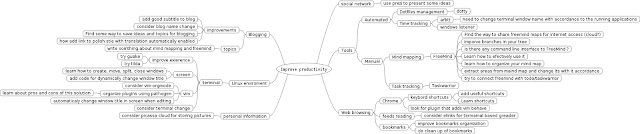
Second I realize that I don’t have methods for storing configs that I use most. I heard about dotfiles tracking with git with cloud help (e.g. github). When I google this issue I found dotty. But after that I ask myself about productivity improvements in broad sense and the conclusion was that my work scheme should be changed. So I try to find some hints about improving productivity, there are thousand of web pages about that. Few things I found useful first of all the idea of “automated time tracking”. Second that chaos that I produced during solving simple problem meant that I thought about controlling of its flow, and this led me to mind mapping technique. AFAIK FreeMind is the best free software for playing with this way of data presentation. Below I attach my first mind map in FreeMind, this is of course beta version.